
The California Homeowner’s Dilemma: Replacement Cost vs. Actual Cash Value
For most California homeowners, insurance isn’t just a bill; it’s a headache. Premiums jumped 40% between 2022 and 2024 for many folks, and finding coverage at all can feel like a scavenger hunt. Insurers are pulling back from places like Ventura County and even parts of the Inland Empire. So, when you finally get a policy in hand, it’s easy to just sign and move on. But here’s the thing: Not all policies are created equal, especially when it comes to what happens after a disaster. Understanding the difference between replacement cost and actual cash value could save you hundreds of thousands of dollars if your home burns down or gets severely damaged.
What is Replacement Cost? Your Best Friend in a Disaster
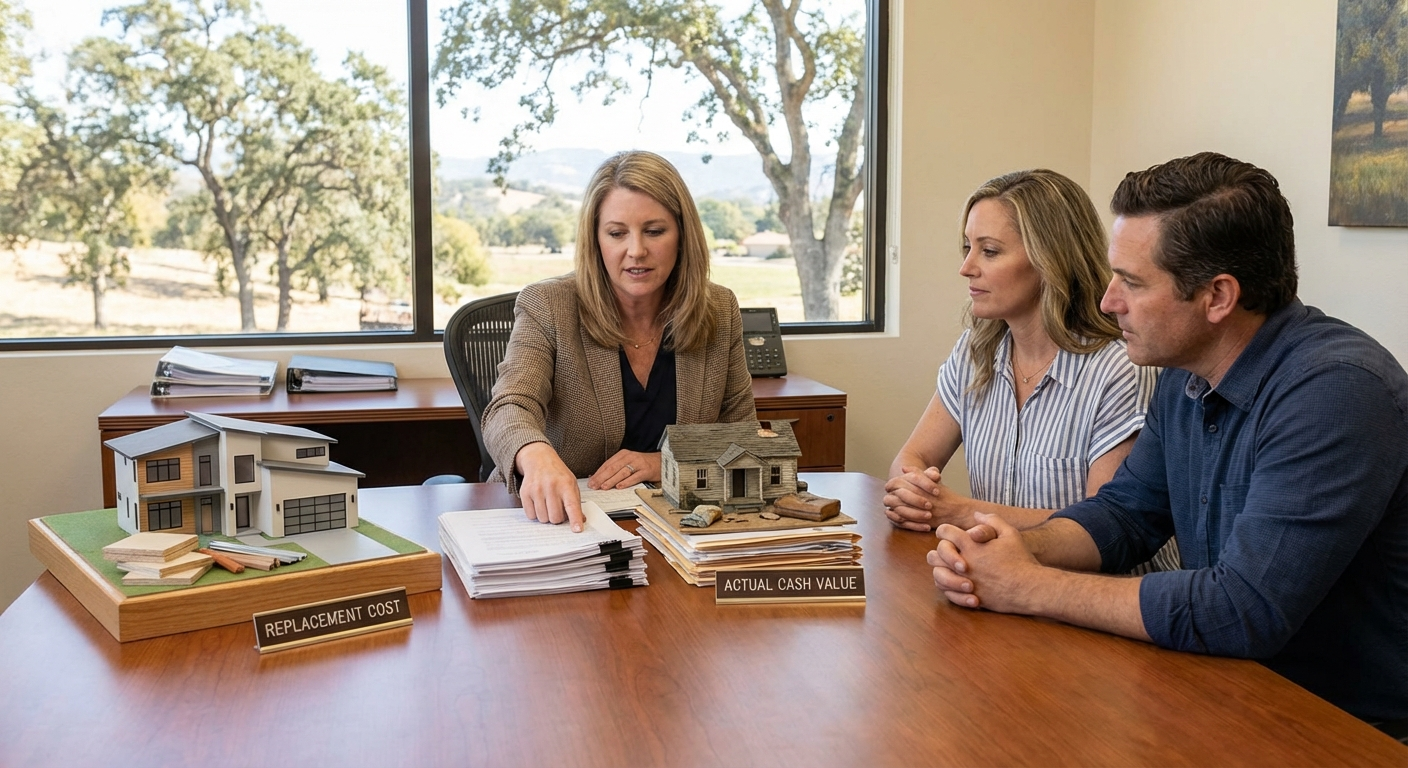
Imagine your home in the Santa Clarita Valley is completely destroyed by fire. You’re devastated, of course. But then you look at your insurance policy. If it’s a replacement cost policy, it means your insurer will pay to rebuild your home *new* — using similar materials and quality — at today’s construction costs. This is the gold standard of coverage.
Think about it: building materials, labor, permits, architect fees. These costs go up every year. A house that cost $300,000 to build in 2005 might cost $700,000 today. A replacement cost policy aims to cover that *current* cost, not what you paid for it, and not what it was worth twenty years ago. You won’t have to factor in depreciation. The goal is to put you back in the same position you were in before the loss, with a new home.
But wait — there’s a catch, even with replacement cost. Most policies have a specific coverage limit for your dwelling. Let’s say your policy says your home is covered for $500,000. If it actually costs $700,000 to rebuild, you’re on the hook for that extra $200,000. That’s why it’s absolutely vital your dwelling coverage limit is high enough. Many insurers offer “extended replacement cost” or “guaranteed replacement cost” options. These can add an extra 20%, 25%, or even 50% on top of your stated dwelling limit, just in case construction costs surge after a major event like the hypothetical 2025 LA fires. This is a smart move in a volatile market like California’s.
Actual Cash Value: A Risky Bet for Your Home
Now, let’s talk about actual cash value (ACV). This is where things get tricky, and often, painful. An ACV policy pays you the replacement cost of your damaged property *minus depreciation*.
What’s depreciation? It’s the decrease in value due to age, wear, and tear. Everything gets older. Everything wears out.
Here’s an example: Your roof in Sacramento is 15 years old. A windstorm rips through, and you need a new one. A brand new roof might cost $20,000. But with an ACV policy, your insurer will calculate how much that 15-year-old roof had depreciated. If a typical roof lasts 20 years, your 15-year-old roof might be considered 75% depreciated. So, instead of $20,000, you might only get $5,000 from your insurer. You’re left to pay the remaining $15,000 out of pocket. Big difference.
This applies not just to your roof, but to your entire home’s structure and your personal belongings. Imagine losing everything in a wildfire in Sonoma County. Your 10-year-old sofa, your 5-year-old TV, your clothes, your kitchen appliances – all would be subject to depreciation. You’d get a check for a fraction of what it would cost to replace those items with new ones.
Honestly, ACV policies are usually cheaper up front. That’s why some people choose them. But that lower premium comes with a massive hidden cost if you ever have a significant claim. For the main structure of your home, an ACV policy is almost never a good idea in California. It leaves you exposed to huge financial losses.
Why This Matters More Than Ever in California
California’s insurance market is in flux. With increased wildfire risks, higher construction costs, and a general tightening of the market, many insurers are getting more conservative. Some are even offering ACV policies for roofs as a way to manage their own risk and keep premiums “lower.” Others, like State Farm and Farmers, have significantly altered their coverage or even stopped writing new policies in certain areas.
Prop 103, passed back in 1988, regulates insurance rates, but it also creates a complex environment where insurers sometimes struggle to price policies accurately for the current risks. This can lead to less coverage available or more restrictive terms. The FAIR Plan, California’s insurer of last resort, often provides ACV coverage for personal property, and sometimes for the dwelling itself, especially in high-risk areas. If you’re on the FAIR Plan, it’s absolutely essential to know exactly what kind of coverage you have.
Construction costs, too, are soaring. Labor shortages, supply chain issues, and demand spikes after a disaster mean rebuilding takes longer and costs more. A replacement cost policy helps insulate you from these market realities. An ACV policy leaves you vulnerable.
Personal Property: Another Crucial Distinction
Your home’s structure is one thing, but what about all your stuff inside? Your furniture, electronics, clothing, kitchenware. Most standard homeowner policies in California offer replacement cost coverage for personal property. This means if your 3-year-old laptop is stolen, you’d get enough money to buy a new, comparable laptop, not just what your old one was worth after depreciation.
But here’s where it gets interesting. Some policies, especially those from non-standard carriers or the FAIR Plan, might default to ACV for personal property. Always check this detail. If you have an ACV personal property policy, that brand new flat-screen TV you bought last year might only get you half its value back if it’s destroyed. You’d have to pay the rest to replace it.
The Role of a Good Agent
Navigating these choices can feel overwhelming, especially with all the changes in the California market. That’s where an independent insurance agent comes in. They don’t work for one specific insurance company; they work for you. They can compare policies from multiple carriers – AAA, Mercury, Travelers, you name it – to find the best fit for your needs and budget.
An agent like Karl Susman of Los Angeles Homeowner Insurance (CA License #OB75129) understands the nuances of the California market. He knows which carriers are still writing policies in places like the Valley, what kind of coverage they’re offering, and how to make sure you’re properly protected. They can explain the fine print, help you understand your dwelling coverage limits, and advise on options like extended replacement cost.
Don’t guess with your biggest asset. It’s too important. If you’re unsure about your current coverage or want to explore options for replacement cost coverage, it’s time to talk to an expert.
Ready to get a home insurance quote that actually protects your future? Get a free quote today!
Frequently Asked Questions About Home Insurance in California
Can I get replacement cost coverage for my roof if it’s really old?
It depends on the insurer and the age of the roof. Some carriers might offer replacement cost for roofs up to a certain age (e.g., 15-20 years), while others might only offer ACV for older roofs or refuse coverage altogether. It’s a key question to ask your agent.
Is “guaranteed replacement cost” truly guaranteed?
Not always. “Guaranteed replacement cost” usually means the insurer will pay *more* than your dwelling limit, sometimes up to 20%, 25%, or 50% extra. It’s not unlimited. It’s designed to cover unexpected spikes in construction costs, but it still has a cap.
Why are some insurers only offering ACV for roofs in California now?
With increasing hail damage, windstorms, and wildfire threats, roofs are a high-risk component of a home. Offering ACV for roofs helps insurers manage their payouts on claims, especially for older roofs, which allows them to offer coverage at a price they deem sustainable in a challenging market.
Does my deductible apply to replacement cost or actual cash value?
Your deductible always applies to the total amount of the covered loss before the insurer pays out. So, if you have a $2,000 deductible and a $20,000 covered loss (whether it’s replacement cost or ACV), you’d pay the first $2,000 and the insurer would pay the remaining $18,000.
What if I can’t find replacement cost coverage in my area?
If standard insurers aren’t offering replacement cost in your area, particularly in high-risk zones, you might need to look at the California FAIR Plan. While it often defaults to ACV for personal property, and sometimes for the dwelling, you can sometimes “wrap” it with a Difference in Conditions (DIC) policy from another insurer to get better coverage, including replacement cost for the dwelling. An agent like Karl Susman can help you figure out these complex solutions.
Don’t leave your home’s future to chance. Understand your policy and make sure it truly protects you.
Want to make sure your California home is properly insured? Get a personalized quote from Karl Susman and his team. Click here to start!
This article is for informational purposes only and does not constitute financial advice.